
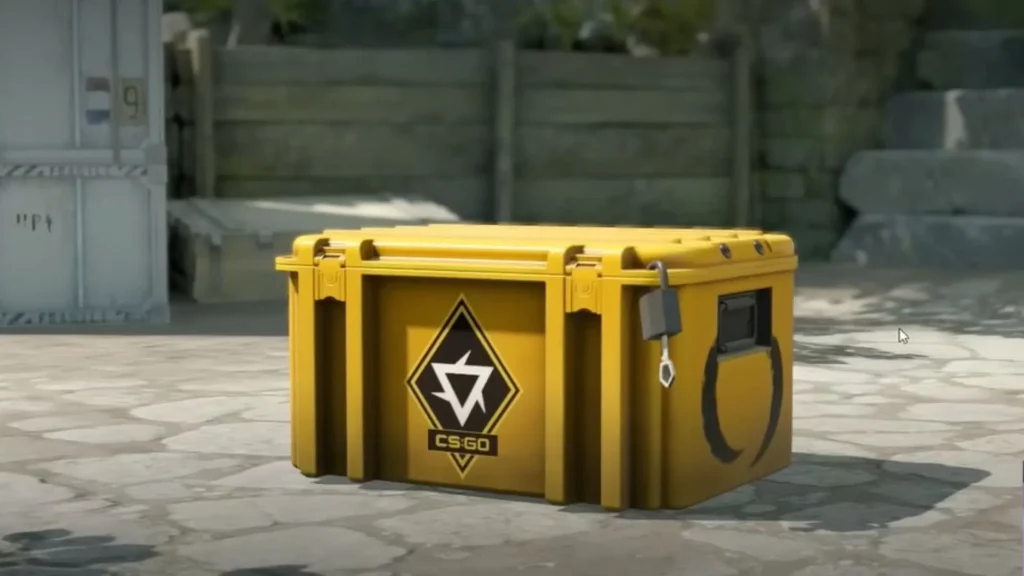
Opening cases is still one of the most common routes to an expensive CS2 skin. Some players hit the knife they were chasing. Most don’t, and the case isn’t really at fault for that, since the odds were published the whole time.
What usually gets skipped is the part before the spending: understanding what actually happens when a case opens. Simulators are the cheapest way to find out.
Case Openings Explained
Before the tools, the mechanic itself. Here is what sits underneath every drop.
What Are CS2 Case Openings?
A case is a sealed container holding a fixed pool of weapon skins. You buy the case, buy a key, open it, and one item from that pool lands in your inventory.
Every case lists its contents publicly, sorted into rarity tiers that run from blue Mil-Spec through Restricted, Classified and Covert, with knives and gloves sitting above all of them as rare special items.
Which item you get is decided at the moment you open, not before. That uncertainty is the entire product. It is the same loot box model used across dozens of games, attached here to items that resell for real money.
Why Players Prefer Opening Cases?
Buying a skin outright is the predictable option: you pay the market price and you own the skin. A case costs a few dollars including the key, and in exchange you get thirty seconds in which a four-figure knife is technically on the table. The distance between what you pay and what you might receive is the whole appeal.
Then there’s the entertainment side. Plenty of players open cases the way other people buy scratch cards, treating each one as a small self-contained event with a result at the end rather than as an investment. Problems tend to start when those two framings get mixed up.
How Random and Trustworthy Is the Mechanism?
The item you receive is selected by a random number generator (RNG), and Valve publishes the odds for each tier: about 79.92% for Mil-Spec, 15.98% for Restricted, 3.2% for Classified, 0.64% for Covert and 0.26% for a rare special item. Wear is rolled separately, which is why two identical Covert skins can differ enormously in price.
So the system is trustworthy in the sense that it does what it advertises. It is not trustworthy in the sense some players want, where a long dry run earns you something better. Each opening is independent of the last. Fifty bad cases do not improve the fifty-first.
How Case Simulators Can Help You?
This is where simulators earn their place. They let you see all of the above happen without paying for it.
What Are Case Opening Simulators?
A case opening simulator is a website or app that reproduces the drop pool and the opening animation using free virtual currency. You pick a case, click open, and the tool rolls an outcome against the published rarity odds.
Nothing you receive exists in your Steam inventory. That’s the point. The simulator gives you the pattern of results, and the pattern is the useful part.
How You Should Use Case Simulators?
Use one as a reference tool rather than as practice, because there is no skill to practise. Open a case you’re curious about a few dozen times and note what you actually accumulate: mostly blues, a scattering of purples, a pink if you keep going. Check the market prices of those common drops against what the case and key cost you.
That comparison does more to set expectations than any amount of reading. It also tells you whether the skins you actually want are worth chasing through cases or just buying directly.
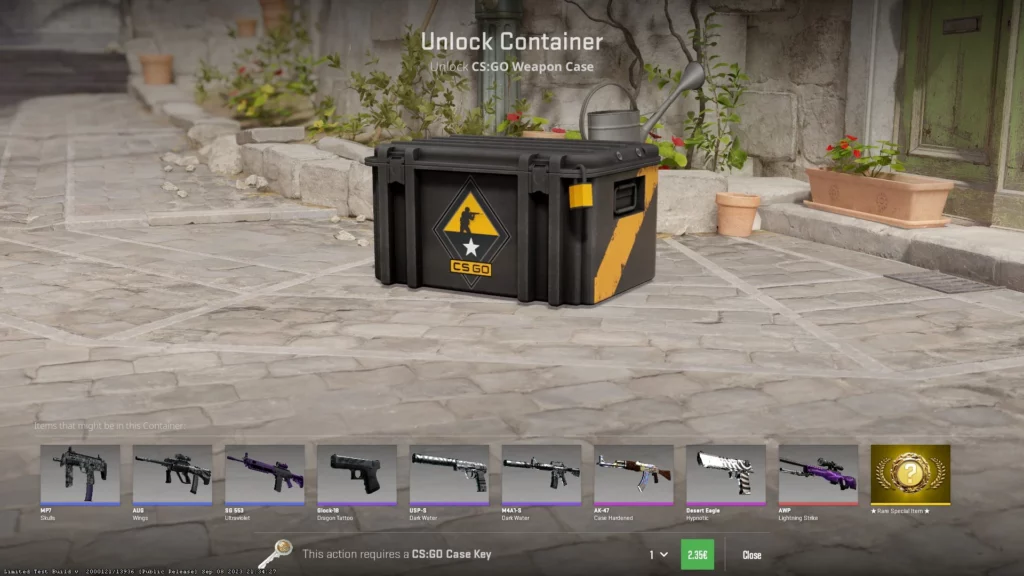
What Simulators Actually Show You?
Run a few hundred openings and the shape of the distribution becomes obvious in a way that percentages on a page never quite manage.
A 0.26% knife chance means roughly one in every 385 cases, and watching 384 of them go past is more instructive than reading the number.
One caveat: a simulator is not running Valve’s RNG. It’s running its own, approximating the published odds.
Most reputable ones stick close to the real figures, but some are tuned to feel generous, so treat any tool that keeps handing you knives as a marketing exercise rather than a model.
Finding Case Simulators
Plenty of these tools exist and quality varies. A few things worth knowing before you pick one.
Where to Find CS2 Case Opening Simulators?
Dedicated skin sites are the usual starting point, and several run a free CS2 case opening mode you can try without depositing anything. Mobile apps cover the same ground, though ad load tends to be heavier.
Steam community hubs and guide sections are useful for a different reason: the tools mentioned there have been seen by other players, and bad ones get flagged in the comments.
Creators who open cases on stream also link the simulators they use, which is a reasonable signal since their audience would notice a broken one.
Should You Use Paid Simulators
Rarely worth it. The core function costs nothing to provide, and free tools cover it fine. Paid platforms usually bundle in price tracking, drop statistics or historical market data, which are genuinely useful features but not simulation features.
If you’re paying, pay for the data and be clear that’s what you’re buying. Check reviews first, and check whether a free market tracker already gives you the same numbers.
How to Avoid Scams and Ensure Safety?
A simulator has no reason to ask for your Steam login, because it isn’t touching your inventory. Any site that asks anyway is worth closing.
Fake login pages built to mimic Steam are among the most common phishing attempts or scams in this space, and the convincing ones are hard to spot by eye.
Same goes for anything requesting your API key, a deposit, or a trade offer to “verify” your account. Check the domain in the address bar character by character, keep Steam Guard mobile authentication switched on, and if you want to test a site you’re unsure about, do it from a throwaway account with nothing in it.
Conclusion
Cases are a simple system with published odds and no memory. Simulators don’t change those odds, but they make them concrete, which is the closest thing to an edge available here.
Open a few hundred cases in a simulator, look at what you ended up with, then decide whether a real case is the right way to get the skin you want. Good luck.
